
 Heavy-Duty SS
Silo Fabrication
Heavy-Duty SS
Silo Fabrication
When dealing with industries that process powdered goods, pellets, grains, and other bulky materials, storage goes hand-in-hand with efficiency in production. The poorly designed storage system will result in either moisture problems, wastage, hard-to-handle products, contamination, and poor discharge. On the other hand, when the silo is designed properly, then the silo becomes an integral part of the handling process.
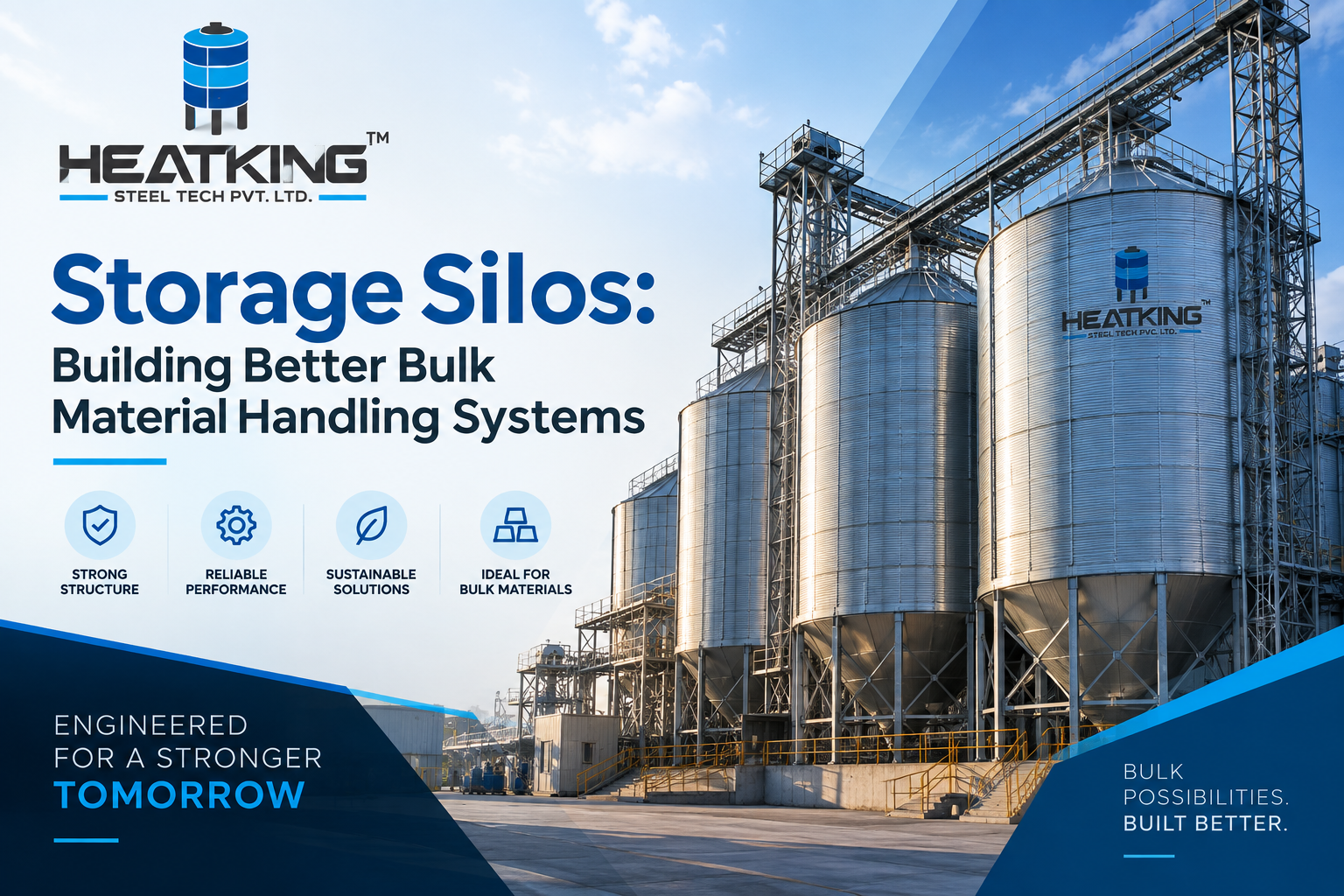
Storage Silos: Building Better Bulk Material Handling Systems
For manufacturers dealing with large quantities of raw materials, choosing the right Storage Silo Manufacturer is therefore not simply a purchasing decision. It is a decision that can influence plant layout, material flow, hygiene, maintenance, and long-term operational reliability.
Vertical Space Optimization
Store large raw material quantities compactly within a reduced footprint.
Consistent Material Flow
Eliminate rat-holing, bridging, and irregular discharge in production lines.
Hygiene & Cleanability
Sanitary smooth internal polishes preventing product cross-contamination.
Custom Engineering
Tailored capacities, structural supports, and automated level sensors.
When Bulk Storage Starts Affecting Production
As production volumes increase, keeping raw materials in smaller containers or floor-level storage areas becomes increasingly difficult. It consumes valuable floor space and can make material movement more labour-intensive.
Vertical silo storage offers a different approach. By making use of available vertical space, large quantities of material can be stored within a relatively compact footprint. Heatking Steel Tech manufactures storage silos with capacities ranging from 1,000 litres to more than 100,000 litres, with custom tonnage also available.
The objective is not simply to store more material. The storage arrangement should also make loading, monitoring, discharge, and replenishment easier to manage.
The Design Has to Follow the Material
Not every bulk material behaves in the same way.
Flour, sugar, starch, plastic pellets, grains, chemical powders, and other materials can have very different flow characteristics. A silo that works effectively for one material may require a different discharge arrangement for another.
This is why silo design needs to consider factors such as particle characteristics, moisture sensitivity, angle of repose, bulk density, required capacity, and discharge requirements.
A properly designed conical bottom can support smoother material flow, while options such as aeration systems, fluidization arrangements, or vibration assistance may be considered where bridging or inconsistent flow could become a concern.
From Loading to Controlled Discharge
Storage becomes more valuable when it integrates naturally with the rest of the production system.
Modern silos can be configured for pneumatic conveying, bucket elevators, rotary valves, screw conveyors, butterfly valves, or slide gates, depending on the application. Dust collection and level monitoring can also be incorporated where required.
This allows the silo to function as part of a complete material-handling system rather than operating as an isolated storage vessel. Properly planned connections can reduce unnecessary manual handling and help maintain a more consistent movement of raw materials through the facility.
Material Selection Matters
The construction material plays an important role in determining where a silo can be used. Industries handling food products, pharmaceuticals, chemicals, or moisture-sensitive materials may have specific requirements related to hygiene, corrosion resistance, and cleanability.
A Stainless Steel Storage Silo can be fabricated using grades such as SS 304, SS 316, or SS 316L, depending on the material being stored and the operating environment. Heatking Steel Tech also lists duplex steel among its available construction materials.
Smooth internal surfaces can also be important where product retention, cleaning, and hygiene need particular attention.
Making the Silo Fit the Plant
A silo should be designed around the facility in which it will operate. Available height, foundation conditions, loading arrangements, access requirements, discharge elevation, and maintenance space all need to be considered before fabrication begins.
Heatking Steel Tech provides customized silo fabrication, including structural supports, access arrangements, dust collection, level sensors, load cells, and other application-specific provisions.
This type of customization is especially useful when a new silo needs to integrate with an existing production line rather than being installed as a standalone unit.
Choosing a Manufacturing Partner
It is not just the thickness of the steel used that determines the quality of the silo; engineering computations, precision in fabrication, the welding process, structural strength, surface finish, and correct attachments all play their parts.
When bulk storage is being considered by an industry for investment, it might be advantageous to deal with a seasoned manufacturer in order to end up with a design suited to the material and its working conditions.
Conclusion
Effective storage of bulk materials requires knowledge of the material itself, how the material is made, and the structure that will store the material. An efficiently designed silo allows companies to save space by ensuring proper loading and discharging.
Looking for a customized storage silo for your industrial application? Contact Heatking Steel Tech to discuss your material, capacity, and plant requirements and develop a solution designed around your process.
