
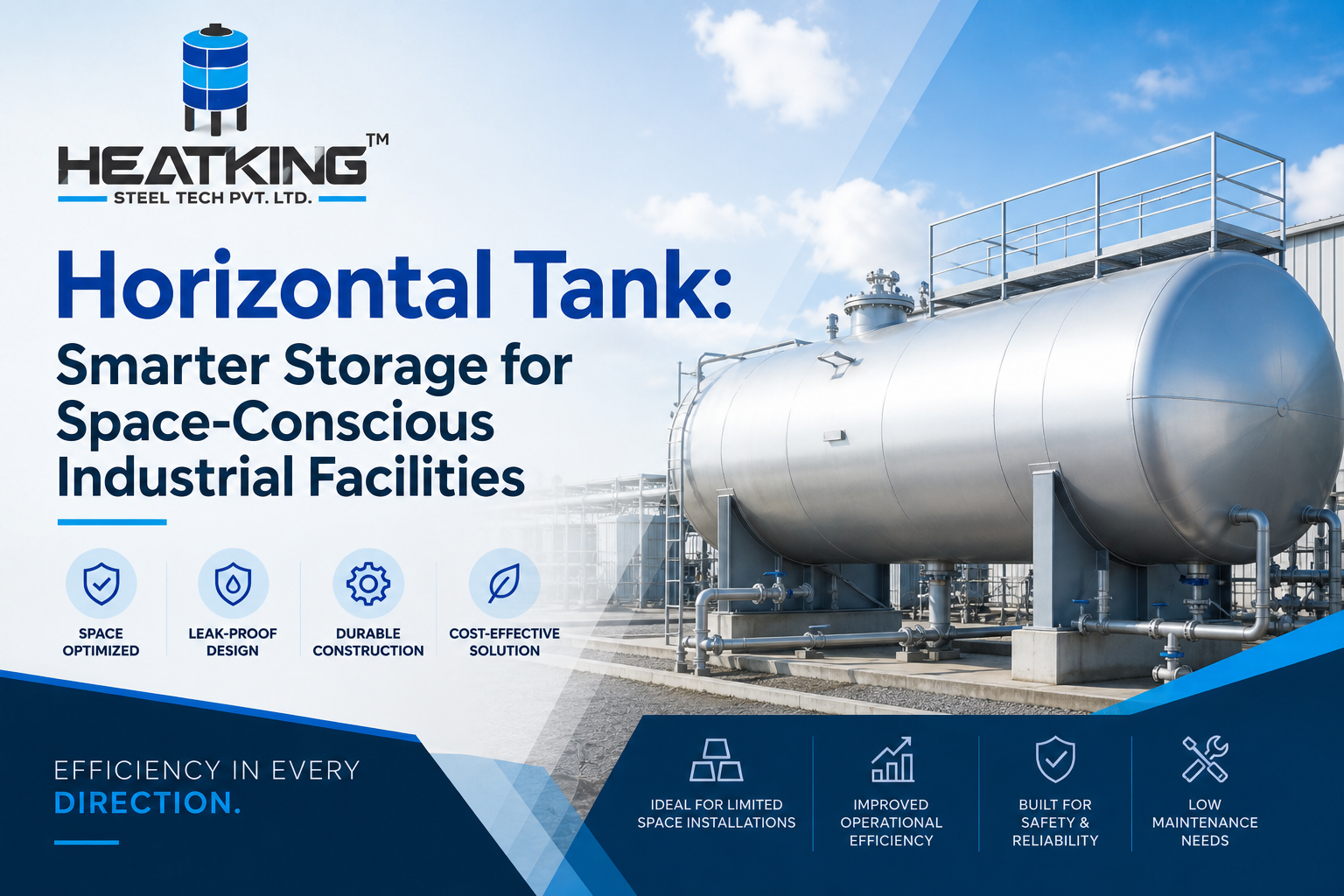
 Space-Saving Horizontal Tank Fabrication
Storage system designs are not typically determined solely based on capacity within an industrial plant. Space availability, ease of access, operating environment, compatibility of materials, and maintenance considerations also play roles in the design of the storage system. For many applications, the horizontal storage tank serves as a practical solution.
Its low-profile arrangement makes it particularly useful where height is restricted or where a stable, ground-level installation is preferred. More importantly, its design can be adapted around the process rather than forcing the process to fit a standard tank configuration.
When Space Becomes Part of the Storage Decision
Industrial plants often have to make the most of every available area. A tall vessel may not always be suitable for facilities with limited headroom, existing structures, or specific installation restrictions.
Horizontal construction provides greater flexibility in such environments. Positioned on suitable saddle supports or a structural frame, the tank can be installed closer to ground level while maintaining a stable configuration.
This arrangement can also make routine access more convenient. Depending on the design, operators can reach inspection points, connections, valves, and other components without dealing with the height associated with large vertical vessels. Choosing a Horizontal Tank Manufacturer like Heatking Steel Tech ensures your storage infrastructure fits seamless inside your facility bounds.
Low-Profile Flexibility
Ideal for facilities with low headroom or strict vertical installation limits.
Ground-Level Accessibility
Convenient operator access to inspection points, valves, and nozzles.
Saddle Support Stability
Balanced weight distribution across sturdy saddles or custom structural frames.
Process Customization
Tailored capacities, internal polishes, and nozzle placements per process requirements.
Designed Around the Process, Not Just Capacity
A storage tank should do more than hold a specified volume of liquid. The material being stored, operating temperature, pressure conditions, installation environment, and frequency of cleaning can all influence the final design.
For example, a tank intended for a hygienic process may require a particular internal surface finish, while one used for aggressive chemicals may need a stainless steel grade selected for better corrosion resistance.
Capacity and dimensions must also work with the available installation area. This is why industrial tank fabrication often involves considerable customization rather than relying on a single standard design.
Where Horizontal Storage Makes Practical Sense
Horizontal storage tanks have a wide range of applications in various industries where liquid storage plays an integral role in the manufacturing process.
They may be used in the food industry to store process liquids such as water, milk, beverages, and syrups among others. Horizontal tanks made out of stainless steel would be useful in pharmaceuticals or cosmetics industries.
A chemical processing facility might need specially designed horizontal tanks for each process liquid or chemical to be stored. The same applies to other industrial processes in dairy, water treatment, oil refining, and other manufacturing processes.
The application varies but the requirement always remains the same.
Material Selection Can Influence Long-Term Performance
The material used to fabricate a tank has a direct impact on its service life and suitability. Stainless steel is widely used in industrial storage because it combines strength, durability, corrosion resistance, and ease of cleaning.
A stainless steel horizontal storage tank can be fabricated using grades such as SS 304, SS 316, or SS 316L, depending on the application. The correct grade should be determined by considering the stored liquid, concentration, temperature, cleaning method, and surrounding environment.
For industries with demanding hygiene or corrosion-resistance requirements, selecting the appropriate material at the design stage can prevent avoidable problems later.
Fabrication Quality Matters as Much as Design
Even a well-planned tank requires careful fabrication to deliver reliable performance. Welding quality, dimensional accuracy, surface finishing, support design, fittings, and inspection all contribute to the final product.
At Heatking Steel Tech, tank fabrication is approached with attention to the specific requirements of the application. Custom dimensions, connections, supports, and other arrangements can be incorporated according to the intended use and installation conditions.
This application-oriented approach is particularly valuable when the tank needs to integrate smoothly with an existing production setup.
Making the Right Storage Choice
Choosing an industrial tank should begin with the process rather than simply selecting a capacity. Businesses should consider the liquid being stored, required volume, operating conditions, available space, material compatibility, access requirements, and future maintenance needs.
A properly designed tank can make storage more manageable while supporting safer and more efficient plant operations. The right manufacturing partner can further simplify the process by translating these requirements into a practical fabrication solution.
Conclusion
Industrial storage works best when the tank is designed around the facility, not the other way around. A horizontal configuration can provide an effective solution where space, accessibility, stability, and process requirements need to work together.
If you are planning a new storage installation or replacing an existing vessel, connect with Heatking Steel Tech to discuss your requirement and develop a customized tank solution suited to your application.
